
Skip to content
Free Excel Tutorials
  • Home
  • Excel For Beginners
  • Excel Intermediate
  • Advanced Excel For Experts

Data Analysis

  • Data Series in Excel
  • How to count table rows in Excel
  • Conditional Formatting Color Scales Examples in Excel
  • Excel Bar Chart
  • How To Create Pareto Chart in Excel

References

  • How to create dynamic named range with OFFSET in Excel
  • Left Lookup in Excel
  • Find Closest Match in Excel Using INDEX, MATCH, ABS and MIN functions
  • How to get last row in numeric data in Excel
  • Multi-criteria lookup and transpose in Excel

Data Validations

  • Excel Data validation no punctuation
  • Excel Data validation must begin with
  • Excel Data validation number multiple 100
  • Data validation must not exist in list
  • Excel Data validation exists in list

How to use Excel ADDRESS Function

by

This Excel tutorial explains how to use the ADDRESS function with syntax and examples.

Excel ADDRESS function Description

The Microsoft Excel ADDRESS function returns a text representation of a cell address.

The ADDRESS function is a built-in function in Excel that is categorized as a Lookup/Reference Function. It can be used as a worksheet function in Excel. As a worksheet function, the ADDRESS function can be entered as part of a formula in a cell of a worksheet.
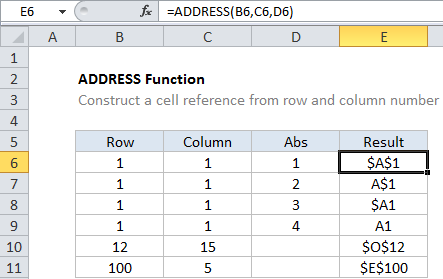
Explanation:  The Excel ADDRESS function returns the address for a cell based on a given row and column number. For example, =ADDRESS(1,1) returns $A$1. ADDRESS can return an address in relative or absolute format, and can be used to construct a cell reference inside a formula.

ADDRESS(1,1) returns $A$1
ADDRESS(1,1,4) returns A1

Syntax

The syntax for the ADDRESS function in Microsoft Excel is:

ADDRESS( row, column, [ref_type], [ref_style], [sheet_name] )

Returns

The ADDRESS function returns a string/text value.

Example

Let’s look at some Excel ADDRESS function examples and explore how to use the ADDRESS function as a worksheet function in Microsoft Excel:

=ADDRESS(4, 5)
Result: "$E$4"

=ADDRESS(4, 5, 1)
Result: "$E$4"

=ADDRESS(4, 5, 2)
Result: "E$4"

=ADDRESS(4, 5, 3)
Result: "$E4"

=ADDRESS(4, 5, 4)
Result: "E4"

=ADDRESS(4, 5, 1, TRUE)
Result: "$E$4"

=ADDRESS(4, 5, 1, FALSE)
Result: "R4C5"

=ADDRESS(4, 5, 1, TRUE, "Sheet1")
Result: "Sheet1!$E$4"

Post navigation

Previous Post:

How to use Excel CHOOSE Function

Next Post:

Customize Ribbon In Excel

Leave a Reply Cancel reply

Your email address will not be published. Required fields are marked *

Learn Basic Excel

Ribbon
Workbook
Worksheets
Format Cells
Find & Select
Sort & Filter
Templates
Print
Share
Protect
Keyboard Shortcuts

Categories

  • Charts
  • Data Analysis
  • Data Validation
  • Excel Functions
    • Cube Functions
    • Database Functions
    • Date and Time Functions
    • Engineering Functions
    • Financial Functions
    • Information Functions
    • Logical Functions
    • Lookup and Reference Functions
    • Math and Trig Functions
    • Statistical Functions
    • Text Functions
    • Web Functions
  • Excel VBA
  • Excel Video Tutorials
  • Formatting
  • Grouping
  • Others

Logical Functions

  • IF, AND, OR and NOT Functions Examples in Excel
  • How to use Excel AND Function
  • SWITCH function example in Excel
  • Complete List of Excel Logical Functions, References and Examples
  • How to use Excel OR Function

Date Time

  • MINUTE function: Description, Usage, Syntax, Examples and Explanation
  • Get days between dates in Excel
  • How to calculate next scheduled event in Excel
  • ISOWEEKNUM function: Description, Usage, Syntax, Examples and Explanation
  • Get days between dates ignoring years in Excel

Grouping

  • If cell contains one of many things in Excel
  • Group arbitrary text values in Excel
  • Categorize text with keywords in Excel
  • Map text to numbers in Excel
  • Group times into unequal buckets in Excel

General

  • How to generate random number weighted probability in Excel
  • Excel Default Templates
  • Subtotal invoices by age in Excel
  • Check if range contains a value not in another range in Excel
  • How to count total columns in range in Excel
© 2026 xlsoffice . All Right Reserved. | Teal Smiles | Abbreviations And Their Meaning