
Skip to content
Free Excel Tutorials
  • Home
  • Excel For Beginners
  • Excel Intermediate
  • Advanced Excel For Experts

Data Analysis

  • How to Use Solver Tool in Excel
  • Conditional Formatting Rules in Excel
  • How to add Trendline to a chart in Excel
  • Working With Tables in Excel
  • Understanding Pivot Tables in Excel

References

  • Extract data with helper column in Excel
  • How to use Excel INDIRECT Function
  • LOOKUP function: Description, Usage, Syntax, Examples and Explanation
  • Two-column Lookup in Excel
  • How to use Excel LOOKUP Function

Data Validations

  • Excel Data validation number multiple 100
  • Excel Data validation date in next 30 days
  • Excel Data validation must not contain
  • Excel Data validation require unique number
  • Excel Data validation whole percentage only

How to generate random date between two dates in Excel

by

To generate random dates between two dates, you can use the RANDBETWEEN function, together with the DATE function. See example below:

Formula

=RANDBETWEEN(date1,date2)
Explanation

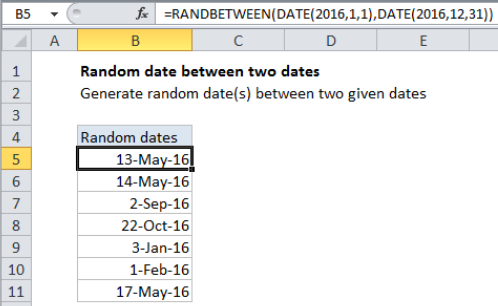
In the example shown, the formula in B5 is:

=RANDBETWEEN(DATE(2016,1,1),DATE(2016,12,31))

This formula is then copied down from B5 to B11. The result is random dates between Jan 1, 2016 and Dec 31, 2016 (random dates in the year 2016).

How this formula works

The RANDBETWEEN function takes two numbers, a bottom and top number, and generates a random integer in between. Dates in Excel are serial numbers, so you can use the DATE function to create the lower number and the upper number. RANDBETWEEN then generates a number that falls between these two date values.

Notes:

  1. That the RANDBETWEEN function will generate new numbers whenever a change is triggered on the worksheet. That includes any edits to the worksheet, also also simply opening the workbook.
  2. The result of this formula must be formatted as a date in order to display correctly.
  3. To prevent random numbers from being calculated again, copy the formulas, then use Paste Special –> Values to replace the formulas with their calculated values.

Random workdays

To generate random workdays, you can add the WORKDAY function like this:

=WORKDAY(RANDBETWEEN(date1,date2)-1,1)

The WORKDAY function ensures that the date returned is a working day, and not a weekend of (optionally) a holiday. Note however WORKDAY will shift dates that fall on weekends or holidays to the next working day, so you may see dates that extend beyond date2.

Post navigation

Previous Post:

DECIMAL function: Description, Usage, Syntax, Examples and Explanation

Next Post:

AVERAGE function: Description, Usage, Syntax, Examples and Explanation

Leave a Reply Cancel reply

Your email address will not be published. Required fields are marked *

Learn Basic Excel

Ribbon
Workbook
Worksheets
Format Cells
Find & Select
Sort & Filter
Templates
Print
Share
Protect
Keyboard Shortcuts

Categories

  • Charts
  • Data Analysis
  • Data Validation
  • Excel Functions
    • Cube Functions
    • Database Functions
    • Date and Time Functions
    • Engineering Functions
    • Financial Functions
    • Information Functions
    • Logical Functions
    • Lookup and Reference Functions
    • Math and Trig Functions
    • Statistical Functions
    • Text Functions
    • Web Functions
  • Excel VBA
  • Excel Video Tutorials
  • Formatting
  • Grouping
  • Others

Logical Functions

  • Return blank if in Excel
  • IFNA function: Description, Usage, Syntax, Examples and Explanation
  • How to use IFS function in Excel
  • AND function: Description, Usage, Syntax, Examples and Explanation
  • How to use Excel XOR Function

Date Time

  • Convert decimal minutes to Excel time
  • Get project end date in Excel
  • Add decimal hours to time in Excel
  • Get project midpoint in Excel
  • Steps to create Dynamic calendar grid in Excel

Grouping

  • Group numbers with VLOOKUP in Excel
  • Running count group by n size in Excel
  • Calculate conditional mode with criteria in Excel
  • Map inputs to arbitrary values in Excel
  • How to randomly assign data to groups in Excel

General

  • Create dynamic workbook reference to another workbook in Excel
  • Find, Select, Replace and Go To Special in Excel
  • Cell References: Relative, Absolute and Mixed Referencing Examples
  • How to Insert Cells, Row and Rows in Excel
  • Subtotal by invoice number in Excel
© 2026 xlsoffice . All Right Reserved. | Teal Smiles | Abbreviations And Their Meaning