

Skip to content
Free Excel Tutorials
  • Home
  • Excel For Beginners
  • Excel Intermediate
  • Advanced Excel For Experts

Data Analysis

  • Conditional Formatting Icon Sets Examples in Excel
  • How To Create Frequency Distribution in Excel
  • Everything about Charts in Excel
  • How To Create Pareto Chart in Excel
  • Number and Text Filters Examples in Excel

References

  • Merge tables with VLOOKUP in Excel
  • How to get last row in mixed data with blanks in Excel
  • How to use Excel FORMULATEXT function
  • How to get last column number in range in Excel
  • Lookup entire row in Excel

Data Validations

  • Excel Data validation allow uppercase only
  • Excel Data validation don’t exceed total
  • Excel Data validation with conditional list
  • Excel Data validation date in next 30 days
  • Prevent invalid data entering in specific cells

How to Create Calendar in Excel

by

This example describes how to create a calendar in Excel (2019 calendar, 2020 calendar, etc). If you are in a hurry.

Note: the instructions below do not teach you how to format the worksheet. We assume that you know how to change font sizes, font styles, insert rows and columns, add borders, change background colors, etc.

This is what January 2020 looks like.
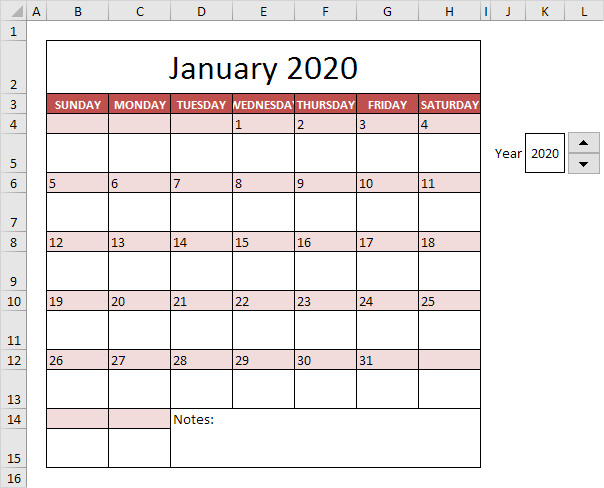
The big question is: how do we tell Excel that January 2020 starts on a Wednesday?

1. First, to make our formulas easier to understand, we have created the following names.

Name Cells
CalendarYear K5
JanOffset =DATE(CalendarYear,1,1)-WEEKDAY(DATE(CalendarYear,1,1))

Explanation: dates are stored as numbers in Excel and count the number of days since January 0, 1900. The Date function returns the number that represents the date. The DATE function accepts three arguments: year, month and day. The WEEKDAY function returns a number from 1 (Sunday) to 7 (Saturday) representing the day of the week of a date. For example, January 1st, 2020 is the same as 43831. This date falls on a Wednesday. In other words, =DATE(CalendarYear,1,1) equals 43831 and WEEKDAY(DATE(CalendarYear,1,1)) equals 4. As a result, JanOffset equals 43831 – 4 = 43827.

2. Let’s take a look at the formula in cell B4.
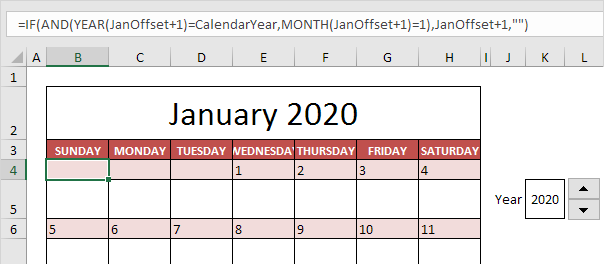
Explanation: JanOffset+1 is nothing more than a date. In fact, it is (4-1) days earlier than January 1st, 2020. This formula checks if the year of this date equals CalendarYear and the month equals January (1). If true, it returns the date. If not, it returns an empty string (“”).

3. Let’s take a look at the formula in cell E4.
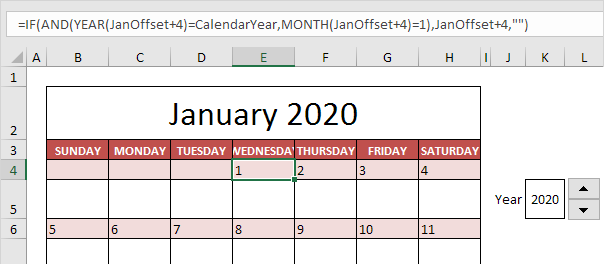
Explanation: JanOffset+4 is nothing more than a date. In fact, it is (4-4) days earlier than January 1st, 2020. This is the first day of the year! This formula checks if the year of this date equals CalendarYear and the month equals January (1). This is true! Excel returns the date.

4. We changed the format to “day format” to only display the day of the month.
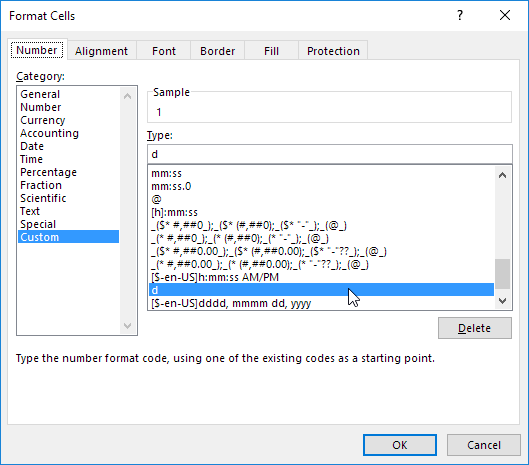
Note: in a similar way, you can create the formulas for the other days in January and the other months. This calendar tool lets you create a calendar for every year you want! Just use the Spin Button to increase the calendar year.

Post navigation

Previous Post:

VLOOKUP without #N/A error in Excel

Next Post:

Manipulating text strings using Left, Mid, Right, Len, Substitute in Excel

Leave a Reply Cancel reply

Your email address will not be published. Required fields are marked *

Learn Basic Excel

Ribbon
Workbook
Worksheets
Format Cells
Find & Select
Sort & Filter
Templates
Print
Share
Protect
Keyboard Shortcuts

Categories

  • Charts
  • Data Analysis
  • Data Validation
  • Excel Functions
    • Cube Functions
    • Database Functions
    • Date and Time Functions
    • Engineering Functions
    • Financial Functions
    • Information Functions
    • Logical Functions
    • Lookup and Reference Functions
    • Math and Trig Functions
    • Statistical Functions
    • Text Functions
    • Web Functions
  • Excel VBA
  • Excel Video Tutorials
  • Formatting
  • Grouping
  • Others

Logical Functions

  • Extract multiple matches into separate rows in Excel
  • SWITCH function example in Excel
  • TRUE function: Description, Usage, Syntax, Examples and Explanation
  • Return blank if in Excel
  • IFERROR function: Description, Usage, Syntax, Examples and Explanation

Date Time

  • Pad week numbers with zeros in Excel
  • Extract time from a date and time in Excel
  • How to get same date next year or previous year in Excel
  • How to enter Today’s Date or Static Date and Time in Excel
  • TIMEVALUE function: Description, Usage, Syntax, Examples and Explanation

Grouping

  • Running count group by n size in Excel
  • Calculate conditional mode with criteria in Excel
  • Group times into 3 hour buckets in Excel
  • If cell contains one of many things in Excel
  • Map text to numbers in Excel

General

  • How to choose page/paper size in Excel before Printing
  • How to generate random number weighted probability in Excel
  • Currency vs Accounting Format in Excel
  • AutoFit Column Width, AutoFit Row Height in Excel
  • How to calculate percent sold in Excel
© 2025 xlsoffice . All Right Reserved. | Teal Smiles | Abbreviations And Their Meaning