
Skip to content
Free Excel Tutorials
  • Home
  • Excel For Beginners
  • Excel Intermediate
  • Advanced Excel For Experts

Data Analysis

  • Use Data Form to input, edit and delete records in Excel
  • How to create a Histogram in Excel
  • How To Sort One Column or Multiple Columns in Excel
  • What-If Analysis: Scenarios and Goal Seek in Excel
  • How to calculate correlation coefficient Correlation in Excel

References

  • How to get relative row numbers in a range in Excel
  • How to retrieve first match between two ranges in Excel
  • Perform case-sensitive Lookup in Excel
  • INDEX function: Description, Usage, Syntax, Examples and Explanation
  • How to use Excel ROWS Function

Data Validations

  • Excel Data validation number multiple 100
  • Excel Data validation only dates between
  • Excel Data validation with conditional list
  • Excel Data validation must contain specific text
  • Excel Data validation allow uppercase only

Count cells over 100 characters in Excel

by

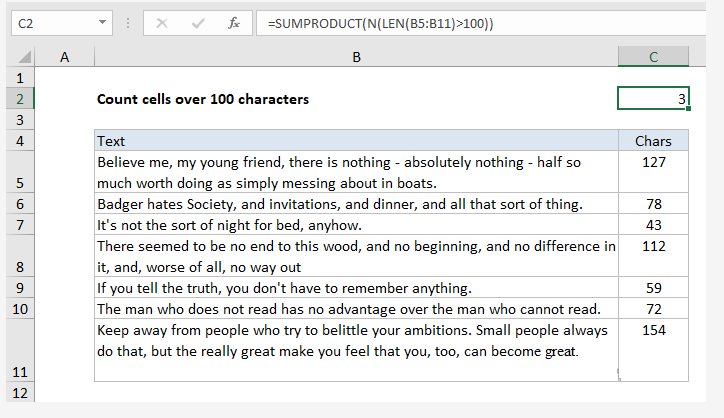
This tutorial shows how to Count cells over 100 characters in Excel using the example below;

Formula

=SUMPRODUCT(N(LEN(range)>100))
Explanation

To count cells that contain more than a certain number of characters you can use a formula based on the SUMPRODUCT, LEN, and N functions. In the example shown, the formula in C2 is:

=SUMPRODUCT(N(LEN(B5:B11)>100))

How this formula works

Working from the inside out, the LEN function runs on the range B5:B11. Because we give LEN multiple values, it returns multiple results in an array like this:

{127;78;43;112;59;72;154}

Which is evaluated against the logical expression >100. This results in an array of TRUE FALSE values:

{TRUE;FALSE;FALSE;TRUE;FALSE;FALSE;TRUE}

The N function then converts these values to ones and zeros:

{1;0;0;1;0;0;1}

Finally, the array is processed by SUMPRODUCT, which returns 3:

=SUMPRODUCT({1;0;0;1;0;0;1})

Post navigation

Previous Post:

How to use Excel CHOOSE Function

Next Post:

Customize Ribbon In Excel

Leave a Reply Cancel reply

Your email address will not be published. Required fields are marked *

Learn Basic Excel

Ribbon
Workbook
Worksheets
Format Cells
Find & Select
Sort & Filter
Templates
Print
Share
Protect
Keyboard Shortcuts

Categories

  • Charts
  • Data Analysis
  • Data Validation
  • Excel Functions
    • Cube Functions
    • Database Functions
    • Date and Time Functions
    • Engineering Functions
    • Financial Functions
    • Information Functions
    • Logical Functions
    • Lookup and Reference Functions
    • Math and Trig Functions
    • Statistical Functions
    • Text Functions
    • Web Functions
  • Excel VBA
  • Excel Video Tutorials
  • Formatting
  • Grouping
  • Others

Logical Functions

  • XOR function: Description, Usage, Syntax, Examples and Explanation
  • Not Equal To ‘<>‘ operator in Excel
  • How to use Excel OR Function
  • Extract multiple matches into separate rows in Excel
  • IF function: Description, Usage, Syntax, Examples and Explanation

Date Time

  • WORKDAY.INTL function: Description, Usage, Syntax, Examples and Explanation
  • Extract date from a date and time in Excel
  • TIME function: Description, Usage, Syntax, Examples and Explanation
  • Display Date is same month in Excel
  • WEEKDAY function: Description, Usage, Syntax, Examples and Explanation

Grouping

  • Categorize text with keywords in Excel
  • Running count group by n size in Excel
  • How to randomly assign people to groups in Excel
  • How to randomly assign data to groups in Excel
  • Map text to numbers in Excel

General

  • How to Delete Cells, Row and Rows in Excel
  • How to generate random number between two numbers in Excel
  • How to calculate total from percentage in Excel
  • List worksheet index numbers in Excel
  • How to choose page/paper size in Excel before Printing
© 2026 xlsoffice . All Right Reserved. | Teal Smiles | Abbreviations And Their Meaning