
Skip to content
Free Excel Tutorials
  • Home
  • Excel For Beginners
  • Excel Intermediate
  • Advanced Excel For Experts

Data Analysis

  • Conditional Formatting Data bars Examples in Excel
  • How to create dynamic reference table name in Excel
  • How to Create Area Chart in Excel
  • Conditional Formatting New Rule with Formulas in Excel
  • Subtotal function in Excel

References

  • Complete List of Excel Lookup and Reference Functions, References and Examples
  • Find closest match in Excel
  • Merge tables with VLOOKUP in Excel
  • How to get address of last cell in range in Excel
  • Last row number in range

Data Validations

  • Excel Data validation number multiple 100
  • Excel Data validation date in specific year
  • Excel Data validation must contain specific text
  • Excel Data validation specific characters only
  • Excel Data validation must begin with

Count cells greater than in Excel

by

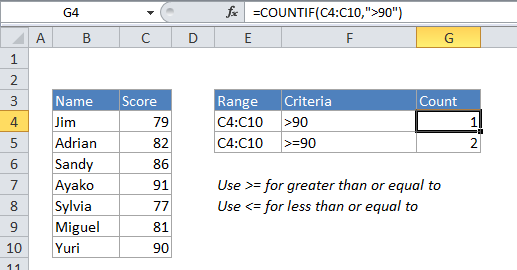
This tutorial shows how to Count cells greater than in Excel using the example below;

Formula

=COUNTIF(range,”>X”)
Explanation

To count the number of cells that have values greater than a particular number, you can use the COUNTIF function. In the example aboveĀ  X represents the threshold above which you want to count.

In the example shown, the active cell contains this formula:

=COUNTIF(C4:C10,">90")

How this formula works

COUNTIF counts the number of cells in the range that contain numeric values greater than X, and returns the result as a number.

If you want to count cells that are greater than or equal to 90, use:

=COUNTIF(C4:C10,">=90")

If you want to use a value in another cell as part of the criteria, use the ampersand (&) character to concatenate like this:

=COUNTIF(range,">"&a1)

If the value in cell a1 is “70”, the criteria will be “>70” after concatenation.

Post navigation

Previous Post:

How to use Excel CHOOSE Function

Next Post:

Customize Ribbon In Excel

Leave a Reply Cancel reply

Your email address will not be published. Required fields are marked *

Learn Basic Excel

Ribbon
Workbook
Worksheets
Format Cells
Find & Select
Sort & Filter
Templates
Print
Share
Protect
Keyboard Shortcuts

Categories

  • Charts
  • Data Analysis
  • Data Validation
  • Excel Functions
    • Cube Functions
    • Database Functions
    • Date and Time Functions
    • Engineering Functions
    • Financial Functions
    • Information Functions
    • Logical Functions
    • Lookup and Reference Functions
    • Math and Trig Functions
    • Statistical Functions
    • Text Functions
    • Web Functions
  • Excel VBA
  • Excel Video Tutorials
  • Formatting
  • Grouping
  • Others

Logical Functions

  • How to use Excel XOR Function
  • OR function Examples in Excel
  • AND function: Description, Usage, Syntax, Examples and Explanation
  • IFS function: Description, Usage, Syntax, Examples and Explanation
  • How to use IFS function in Excel

Date Time

  • Add decimal minutes to time in Excel
  • Roll back weekday to Friday base on a particular date in Excel
  • NOW function: Description, Usage, Syntax, Examples and Explanation
  • Calculate expiration date in Excel
  • How to determine year is a leap year in Excel

Grouping

  • How to randomly assign data to groups in Excel
  • Running count group by n size in Excel
  • Group numbers with VLOOKUP in Excel
  • How to randomly assign people to groups in Excel
  • Map text to numbers in Excel

General

  • Excel Operators
  • Lock Cells in a Worksheet Excel
  • Zoom Worksheet in Excel
  • How to add sequential row numbers to a set of data in Excel
  • With vs Without Array Formula in Excel
© 2026 xlsoffice . All Right Reserved. | Teal Smiles | Abbreviations And Their Meaning