
Skip to content
Free Excel Tutorials
  • Home
  • Excel For Beginners
  • Excel Intermediate
  • Advanced Excel For Experts

Data Analysis

  • Get column name from index in Excel Table
  • Chart Axes in Excel
  • How to Use Solver Tool in Excel
  • Excel Pie Chart
  • How to conditionally sum numeric data in an Excel table using SUMIFS

References

  • Find closest match in Excel
  • How to get last row in numeric data in Excel
  • How to use Excel LOOKUP Function
  • Extract all partial matches in Excel
  • Approximate match with multiple criteria in Excel

Data Validations

  • Data validation must not exist in list
  • Excel Data validation no punctuation
  • Excel Data validation must begin with
  • Excel Data validation unique values only
  • Excel Data validation whole percentage only

Highlight rows with blank cells in Excel

by

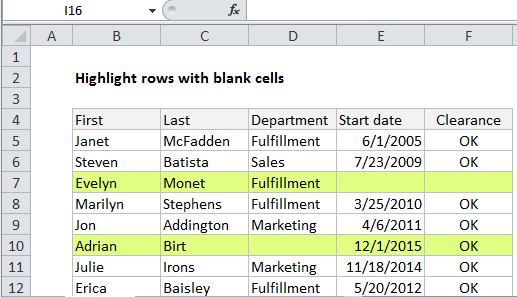
This tutorial shows how to Highlight rows with blank cells in Excel using the example below;

Formula

=COUNTBLANK($B5:$F5)
Explanation

To highlight rows that contain one or more blank cells. you can conditional formatting with a simple formula based on the COUNTBLANK function.

In the example shown, the range B5:F15 is formatted with a conditional formatting rule based on this formula:

=COUNTBLANK($B5:$F5)

Note: it’s important that CF formulas be entered relative to the “first cell” in the selection, B5 in this case.

Once you save the rule, you’ll see the rows that contain one or more blank cells highlighted.

How this formula works

Conditional formatting is applied to all cells in the active selection at the time a rule is created.

In this case, the column references are locked to prevent columns from changing as the formula is evaluated, but the row references are relative so that row numbers are free to change. The result is a formula that applies exactly the same logic to every cell in the same row.

If COUNTBLANK finds any blank cells in a given row, it returns a positive number, which Excel evaluates to TRUE,  triggering the rule.

If COUNTBLANK finds no blank cells, it returns zero, which is evaluated as FALSE, and the formatting is not triggered.

Post navigation

Previous Post:

COSH function: Description, Usage, Syntax, Examples and Explanation

Next Post:

Excel Data validation require unique number

Leave a Reply Cancel reply

Your email address will not be published. Required fields are marked *

Learn Basic Excel

Ribbon
Workbook
Worksheets
Format Cells
Find & Select
Sort & Filter
Templates
Print
Share
Protect
Keyboard Shortcuts

Categories

  • Charts
  • Data Analysis
  • Data Validation
  • Excel Functions
    • Cube Functions
    • Database Functions
    • Date and Time Functions
    • Engineering Functions
    • Financial Functions
    • Information Functions
    • Logical Functions
    • Lookup and Reference Functions
    • Math and Trig Functions
    • Statistical Functions
    • Text Functions
    • Web Functions
  • Excel VBA
  • Excel Video Tutorials
  • Formatting
  • Grouping
  • Others

Logical Functions

  • How to use IFS function in Excel
  • Return blank if in Excel
  • IF, AND, OR and NOT Functions Examples in Excel
  • IF with boolean logic in Excel
  • IF with wildcards in Excel

Date Time

  • Convert text timestamp into time in Excel
  • Next biweekly payday from date in Excel
  • Convert text to date in Excel
  • Convert date string to date time in Excel
  • Add days to date in Excel

Grouping

  • Calculate conditional mode with criteria in Excel
  • Map inputs to arbitrary values in Excel
  • How to randomly assign data to groups in Excel
  • How to randomly assign people to groups in Excel
  • Running count group by n size in Excel

General

  • How to fill cell ranges with random number from fixed set of options in Excel
  • How to calculate percent of goal in Excel
  • Find, Select, Replace and Go To Special in Excel
  • Flash Fill in Excel
  • How to create dynamic named range with INDEX in Excel
© 2026 xlsoffice . All Right Reserved. | Teal Smiles | Abbreviations And Their Meaning