

Skip to content
Free Excel Tutorials
  • Home
  • Excel For Beginners
  • Excel Intermediate
  • Advanced Excel For Experts

Data Analysis

  • Move chart to a separate worksheet in Excel
  • How To Compare Two Lists in Excel
  • How to create running total in an Excel Table
  • How To Load Analysis ToolPak in Excel
  • Get column name from index in Excel Table

References

  • MATCH function: Description, Usage, Syntax, Examples and Explanation
  • How to use Excel MMULT Function
  • How to get relative column numbers in a range in Excel
  • How to get relative row numbers in a range in Excel
  • Excel Advanced Lookup using Index and Match Functions

Data Validations

  • Excel Data validation date in next 30 days
  • Excel Data validation number multiple 100
  • Excel Data validation date in specific year
  • Excel Data validation no punctuation
  • Prevent invalid data entering in specific cells

Join Text Strings Using Concatenate or ‘& Operator’ in Excel

by

This example illustrates how to concatenate (join) strings in Excel. When joining text and a number, use the TEXT function to format that number.

1. Simply use the & operator to join strings.
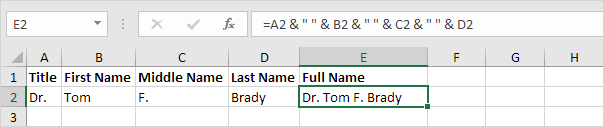
Note: to insert a space, use ” ”

2. The CONCATENATE function produces the exact same result.
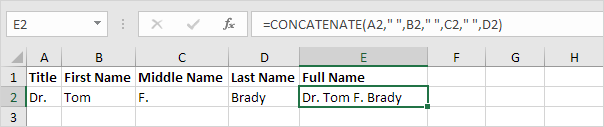
3a. The CONCAT function in Excel 2016 produces the exact same result.
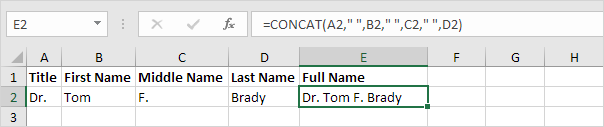
3b. The CONCAT function can also join a range of strings. If you don’t need a delimiter (space, comma, dash, etc.) this can be useful.

4a. The CONCAT function cannot ignore empty cells. Take a look at all the extra spaces in column E below when you drag the function in cell E2 down to cell E11.
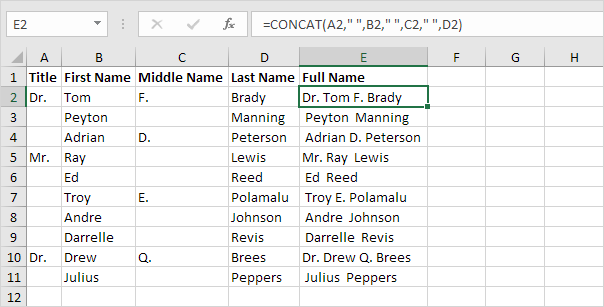
4b. The beauty of the TEXTJOIN function in Excel 2016 is that it can ignore empty cells (if the second argument is set to TRUE).
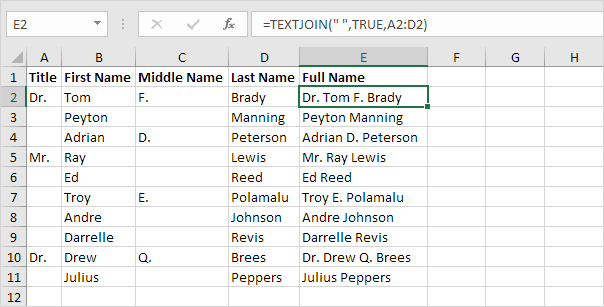
Note: the TEXTJOIN function joins a range of strings using a delimiter (first argument).

5a. When joining text and a number, use the TEXT function to format that number. Without using the TEXT function this would be the result.

5b. With the TEXT function.

Note: #,## is used to add comma’s to large numbers. Use 0 to display the nearest integer value. Use 0.0 for one decimal place. Use 0.00 for two decimal places, etc. You can also use the TEXT function to apply a percentage format and to format a date.

6. When concatenating strings, use CHAR(10) to insert a line break. For example, the address below contains two line breaks.
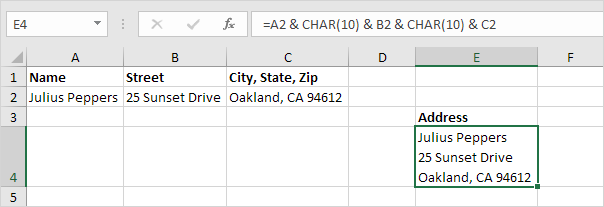
Note: don’t forget to enable text wrapping.

Post navigation

Previous Post:

VLOOKUP without #N/A error in Excel

Next Post:

Manipulating text strings using Left, Mid, Right, Len, Substitute in Excel

Leave a Reply Cancel reply

Your email address will not be published. Required fields are marked *

Learn Basic Excel

Ribbon
Workbook
Worksheets
Format Cells
Find & Select
Sort & Filter
Templates
Print
Share
Protect
Keyboard Shortcuts

Categories

  • Charts
  • Data Analysis
  • Data Validation
  • Excel Functions
    • Cube Functions
    • Database Functions
    • Date and Time Functions
    • Engineering Functions
    • Financial Functions
    • Information Functions
    • Logical Functions
    • Lookup and Reference Functions
    • Math and Trig Functions
    • Statistical Functions
    • Text Functions
    • Web Functions
  • Excel VBA
  • Excel Video Tutorials
  • Formatting
  • Grouping
  • Others

Logical Functions

  • IF, AND, OR and NOT Functions Examples in Excel
  • Return blank if in Excel
  • OR function Examples in Excel
  • Invoice status with nested if in Excel
  • NOT function: Description, Usage, Syntax, Examples and Explanation

Date Time

  • Get week number from date in Excel
  • Convert date to text in Excel
  • Sum race time splits in Excel
  • Sum through n months in Excel
  • Get project end date in Excel

Grouping

  • Group numbers at uneven intervals in Excel
  • Group times into unequal buckets in Excel
  • Calculate conditional mode with criteria in Excel
  • Categorize text with keywords in Excel
  • Map text to numbers in Excel

General

  • How to generate random number weighted probability in Excel
  • Excel Default Templates
  • How to calculate percent variance in Excel
  • How to test a range for numbers in Excel
  • Create dynamic workbook reference to another workbook in Excel
© 2026 xlsoffice . All Right Reserved. | Teal Smiles | Abbreviations And Their Meaning