
Skip to content
Free Excel Tutorials
  • Home
  • Excel For Beginners
  • Excel Intermediate
  • Advanced Excel For Experts

Data Analysis

  • How To Filter Data in Excel
  • Randomize/ Shuffle List in Excel
  • How To Compare Two Lists in Excel
  • How to Create One and Two Variable Data Tables in Excel
  • Error Bars in Excel

References

  • How to use Excel TRANSPOSE Function
  • Get nth match with INDEX / MATCH in Excel
  • How to get relative column numbers in a range in Excel
  • How to get address of first cell in range in Excel
  • INDEX function: Description, Usage, Syntax, Examples and Explanation

Data Validations

  • Excel Data validation allow uppercase only
  • Excel Data validation must begin with
  • Excel Data validation must contain specific text
  • Data validation must not exist in list
  • Excel Data validation number multiple 100

How to get last line in cell in Excel

by

To get the last word from a text string, you can use a formula based on the TRIM, SUBSTITUTE, RIGHT, and REPT functions.

Formula

=TRIM(RIGHT(SUBSTITUTE(B5,CHAR(10),REPT(" ",200)),200))
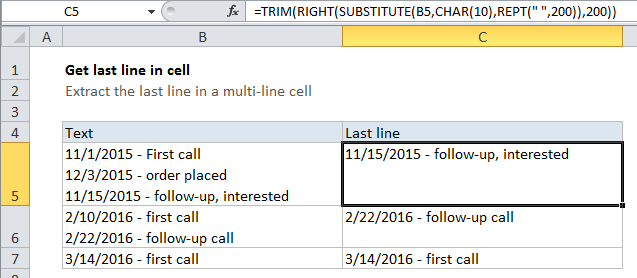
Note: 200 is an arbitrary number that represents the longest line you expect to find in a cell. If you have longer lines, increase this number as needed.

Explanation

In the example shown, the formula in C5 is:

=TRIM(RIGHT(SUBSTITUTE(B5,CHAR(10),REPT(" ",200)),200))

How this formula works

This formula takes advantage of the fact that TRIM will remove any number of leading spaces. We look for line breaks and “flood” the text with spaces where we find one. Then we come back and grab text from the right.

Working from the inside out, we use the SUBSTITUTE function to find all line breaks (char 10)  in the text, and replace each one with 200 spaces:

SUBSTITUTE(B5,CHAR(10),REPT(" ",200))

After the substitution, the looks like this (with hyphens marking spaces for readability):

line one----------line two----------line three

With 200 spaces between each line of text.

Next, the RIGHT function extracts 200 characters, starting from the right. The result will look like this:

-------line three

Finally, the TRIM function removes all leading spaces, and returns the last line.


Post navigation

Next Post:

Create One-dimensional and Two-dimensional Array

Leave a Reply Cancel reply

Your email address will not be published. Required fields are marked *

Learn Basic Excel

Ribbon
Workbook
Worksheets
Format Cells
Find & Select
Sort & Filter
Templates
Print
Share
Protect
Keyboard Shortcuts

Categories

  • Charts
  • Data Analysis
  • Data Validation
  • Excel Functions
    • Cube Functions
    • Database Functions
    • Date and Time Functions
    • Engineering Functions
    • Financial Functions
    • Information Functions
    • Logical Functions
    • Lookup and Reference Functions
    • Math and Trig Functions
    • Statistical Functions
    • Text Functions
    • Web Functions
  • Excel VBA
  • Excel Video Tutorials
  • Formatting
  • Grouping
  • Others

Logical Functions

  • IF function: Description, Usage, Syntax, Examples and Explanation
  • How to use Excel NOT Function
  • IFNA function: Description, Usage, Syntax, Examples and Explanation
  • How to return blank in place of #DIV/0! error in Excel
  • NOT function: Description, Usage, Syntax, Examples and Explanation

Date Time

  • DAYS360 function: Description, Usage, Syntax, Examples and Explanation
  • Display Date is workday in Excel
  • Calculate number of hours between two times in Excel
  • Convert text timestamp into time in Excel
  • Pad week numbers with zeros in Excel

Grouping

  • If cell contains one of many things in Excel
  • Group times into unequal buckets in Excel
  • Group times into 3 hour buckets in Excel
  • Categorize text with keywords in Excel
  • Running count group by n size in Excel

General

  • How to password protect excel sheet?
  • Convert column number to letter in Excel
  • AutoRecover file that was never saved in Excel
  • Find, Select, Replace and Go To Special in Excel
  • Sum by group in Excel
© 2026 xlsoffice . All Right Reserved. | Teal Smiles | Abbreviations And Their Meaning