
Skip to content
Free Excel Tutorials
  • Home
  • Excel For Beginners
  • Excel Intermediate
  • Advanced Excel For Experts

Data Analysis

  • Subtotal function in Excel
  • Working With Tables in Excel
  • Filter Data Based on Date in Excel
  • Example of COUNTIFS with variable table column in Excel
  • How To Remove Duplicates In Excel Column Or Row?

References

  • Offset in Excel
  • INDEX function: Description, Usage, Syntax, Examples and Explanation
  • How to get last row in mixed data with blanks in Excel
  • CHOOSE function: Description, Usage, Syntax, Examples and Explanation
  • Two-way lookup with VLOOKUP in Excel

Data Validations

  • Data validation must not exist in list
  • Excel Data validation unique values only
  • Excel Data validation no punctuation
  • Excel Data validation allow weekday only
  • Excel Data validation with conditional list

How to check if cell contains some words but not others in Excel

by

To test a cell to see if contains certain words but not others, you can use an array formula based on the COUNT and SEARCH functions, wrapped in the AND function.

Formula

{=AND(COUNT(SEARCH(inc,A1))>0,COUNT(SEARCH(exc,A1))=0)}
Explanation

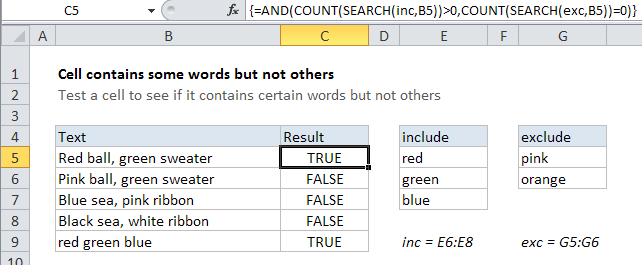
In the example shown, the formula in C5 is:

{=AND(COUNT(SEARCH(inc,B5))>0,COUNT(SEARCH(exc,B5))=0)}

This formula returns TRUE when B5 contains any of the words in the named range inc and none of the words in the named range exc.

This is an array formula and must be entered with Control + Shift + Enter.

How this formula works

This formula relies on the AND function to test two conditions at the same time:

  1. Count of words from named range inc is >0
  2. Count of words from named range exc is =0

If both conditions are TRUE, the formula returns TRUE. If either condition is FALSE, the formula returns FALSE.

The test for multiple words is done using the SEARCH function with help from COUNT.

When SEARCH receives more than one item to look for, it returns an array of results, one per item. When a match is found, SEARCH returns the position of the match. When no match is found, SEARCH returns the #VALUE error. The COUNT function gets a count of numbers in the array returned by SEARCH. COUNT ignores errors by default.

In the example shown, the formula is solved in steps like this

=AND(COUNT({1;11;#VALUE!})>0,COUNT({#VALUE!;#VALUE!})=0)
=AND(2>0,0=0)
=AND(TRUE,TRUE)
=TRUE

With hard-coded values

There’s no requirement that you use a range for your list of things. If you’re only looking for a small number of things, you can use a list in array format, which is called an array constant. For example, to test for red, blue, or green, but exclude pink and orange, you can use:

=AND(COUNT(SEARCH({"red","blue","green"},B5))>0,COUNT(SEARCH({"orange","pink"},B5))=0)

This version does not require the control + shift + enter array formula syntax.

Post navigation

Previous Post:

DECIMAL function: Description, Usage, Syntax, Examples and Explanation

Next Post:

AVERAGE function: Description, Usage, Syntax, Examples and Explanation

Leave a Reply Cancel reply

Your email address will not be published. Required fields are marked *

Learn Basic Excel

Ribbon
Workbook
Worksheets
Format Cells
Find & Select
Sort & Filter
Templates
Print
Share
Protect
Keyboard Shortcuts

Categories

  • Charts
  • Data Analysis
  • Data Validation
  • Excel Functions
    • Cube Functions
    • Database Functions
    • Date and Time Functions
    • Engineering Functions
    • Financial Functions
    • Information Functions
    • Logical Functions
    • Lookup and Reference Functions
    • Math and Trig Functions
    • Statistical Functions
    • Text Functions
    • Web Functions
  • Excel VBA
  • Excel Video Tutorials
  • Formatting
  • Grouping
  • Others

Logical Functions

  • IF with wildcards in Excel
  • Return blank if in Excel
  • How to use Excel TRUE Function
  • How to use Excel AND Function
  • Extract multiple matches into separate rows in Excel

Date Time

  • Create date range from two dates in Excel
  • Calculate series of dates by workdays in Excel
  • Get last working day in month in Excel
  • TODAY function: Description, Usage, Syntax, Examples and Explanation
  • DAYS function: Description, Usage, Syntax, Examples and Explanation

Grouping

  • If cell contains one of many things in Excel
  • How to randomly assign data to groups in Excel
  • Running count group by n size in Excel
  • Group times into 3 hour buckets in Excel
  • How to randomly assign people to groups in Excel

General

  • Automatically fill series of cells in Excel using AutoFill
  • Transpose: Switch ‘Rows to Columns’ or ‘Columns to Rows’ in Excel
  • Creating and Opening an existing file in Excel
  • How to calculate decrease by percentage in Excel
  • How to calculate percent sold in Excel
© 2026 xlsoffice . All Right Reserved. | Teal Smiles | Abbreviations And Their Meaning