
Skip to content
Free Excel Tutorials
  • Home
  • Excel For Beginners
  • Excel Intermediate
  • Advanced Excel For Experts

Data Analysis

  • How To Remove Duplicates In Excel Column Or Row?
  • Understanding Anova in Excel
  • How to Sort by Color in Excel
  • Reverse List in Excel
  • How to create Gauge Chart in Excel

References

  • Last row number in range
  • Count rows that contain specific values in Excel
  • Create hyperlink with VLOOKUP in Excel
  • Multi-criteria lookup and transpose in Excel
  • How to get first column number in range in Excel

Data Validations

  • Excel Data validation exists in list
  • Prevent invalid data entering in specific cells
  • Excel Data validation whole percentage only
  • Excel Data validation require unique number
  • Excel Data validation no punctuation

How to Capitalize first letter in a sentence in Excel

by

This tutorial shows how to capitalize first letter in Excel.

In Microsoft office word it is called sentence case, in Excel to capitalize the first letter in a word or string, you can use a formula based on the LEFT, MID, and LEN functions.

Formula

=UPPER(LEFT(A1))&MID(A1,2,LEN(A1))
Explanation

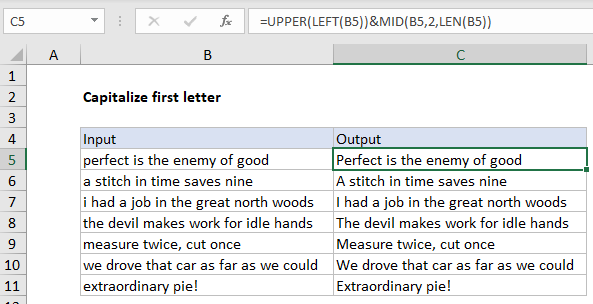
 In the example shown, the formula in C5 is:

=UPPER(LEFT(B5))&MID(B5,2,LEN(B5))

How this formula works

The first expression uses LEFT and UPPER to capitalize the first letter:

=UPPER(LEFT(B5))

No need to enter 1 for num_chars in LEFT, since it will default to 1. The second expression extracts the remaining characters with MID:

MID(B5,2,LEN(B5))

The text comes from B5, the start number is hardcoded as 2, and num_chars is provided by the LEN function. Technically, we only need to extract (length – 1) characters, but MID won’t complain if we ask for more characters, so we’ve left things in the simplest form.

Lowercase the rest

If you want to lowercase everything but the first letter, just wrap the second expression in the LOWER function:

=UPPER(LEFT(B5))&LOWER(MID(B5,2,LEN(B5)))

The LOWER function will force all remaining characters to lower case. You can also visit how to Change Case to Uppercase, Lowercase, Propercase in Excel

Post navigation

Previous Post:

DECIMAL function: Description, Usage, Syntax, Examples and Explanation

Next Post:

AVERAGE function: Description, Usage, Syntax, Examples and Explanation

Leave a Reply Cancel reply

Your email address will not be published. Required fields are marked *

Learn Basic Excel

Ribbon
Workbook
Worksheets
Format Cells
Find & Select
Sort & Filter
Templates
Print
Share
Protect
Keyboard Shortcuts

Categories

  • Charts
  • Data Analysis
  • Data Validation
  • Excel Functions
    • Cube Functions
    • Database Functions
    • Date and Time Functions
    • Engineering Functions
    • Financial Functions
    • Information Functions
    • Logical Functions
    • Lookup and Reference Functions
    • Math and Trig Functions
    • Statistical Functions
    • Text Functions
    • Web Functions
  • Excel VBA
  • Excel Video Tutorials
  • Formatting
  • Grouping
  • Others

Logical Functions

  • IF with boolean logic in Excel
  • SWITCH function: Description, Usage, Syntax, Examples and Explanation
  • NOT function: Description, Usage, Syntax, Examples and Explanation
  • Nested IF function example in Excel
  • How to use Excel OR Function

Date Time

  • Get project end date in Excel
  • Convert Unix time stamp to Excel date
  • How to get year from date in Excel
  • How to show last updated date stamp in Excel
  • DAYS function: Description, Usage, Syntax, Examples and Explanation

Grouping

  • How to randomly assign people to groups in Excel
  • Group arbitrary text values in Excel
  • Group numbers at uneven intervals in Excel
  • Categorize text with keywords in Excel
  • Running count group by n size in Excel

General

  • Hide and Unhide Columns or Rows in Excel
  • List worksheet index numbers in Excel
  • Spell Check in Excel
  • Automatically fill series of cells in Excel using AutoFill
  • How to count total number of cells in a rectangular range in Excel
© 2025 xlsoffice . All Right Reserved. | Teal Smiles | Abbreviations And Their Meaning