
Skip to content
Free Excel Tutorials
  • Home
  • Excel For Beginners
  • Excel Intermediate
  • Advanced Excel For Experts

Data Analysis

  • How to calculate correlation coefficient Correlation in Excel
  • Randomize/ Shuffle List in Excel
  • How to conditionally sum numeric data in an Excel table using SUMIFS
  • Number and Text Filters Examples in Excel
  • How To Sort One Column or Multiple Columns in Excel

References

  • Extract all partial matches in Excel
  • How to get first column number in range in Excel
  • VLOOKUP function: Description, Usage, Syntax, Examples and Explanation
  • LOOKUP function: Description, Usage, Syntax, Examples and Explanation
  • How to use Excel TRANSPOSE Function

Data Validations

  • Excel Data validation unique values only
  • Excel Data validation must not contain
  • How To Create Drop-down List in Excel
  • Excel Data validation number multiple 100
  • Data validation must not exist in list

9 Mathematical Computations Example using Excel Statistical Function

by

In addition to formulas, another way to conduct mathematical computations in Excel is through functions. Statistical functions apply a mathematical process to a group of cells in a worksheet.

This chapter gives an overview of some very useful statistical functions like: AVERAGE function, AVERAGEIF function, MEDIAN function, SUMIF function, MIN function, MODE function, STEDV function, LARGE function, SMALL function.

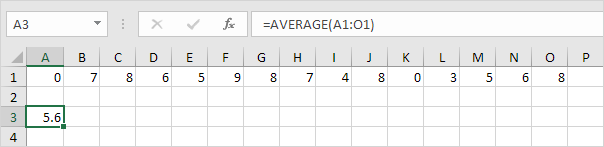
Average

To calculate the average of a range of cells, use the AVERAGE function.
Averageif

To average cells based on one criteria, use the AVERAGEIF function. For example, to calculate the average excluding zeros.
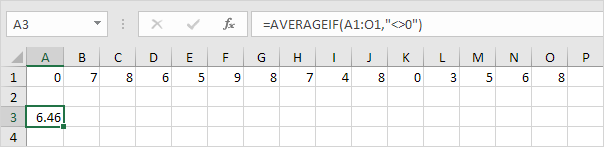
Note: <> means not equal to. The AVERAGEIF function is similar to the SUMIF function.

Median

To find the median (or middle number), use the MEDIAN function.
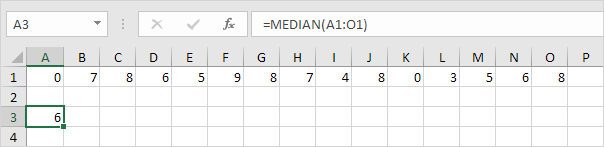
Check:

Mode

To find the most frequently occurring number, use the MODE function.
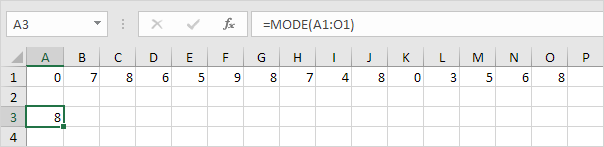
Standard Deviation

To calculate the standard deviation, use the STEDV function.
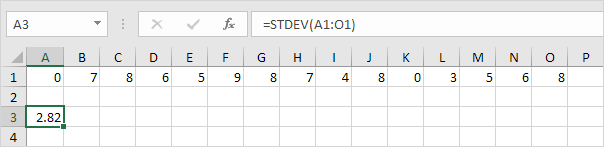
Note: standard deviation is a number that tells you how far numbers are from their mean. Learn more about this topic on our page about standard deviation.

Min

To find the minimum value, use the MIN function.
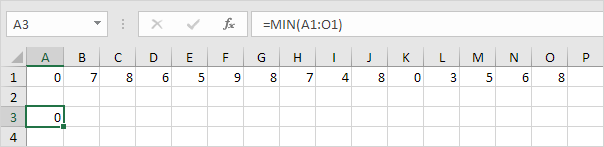
Max

To find the maximum value, use the MAX function.
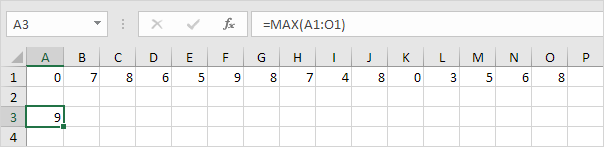
Large

To find the third largest number, use the following LARGE function.
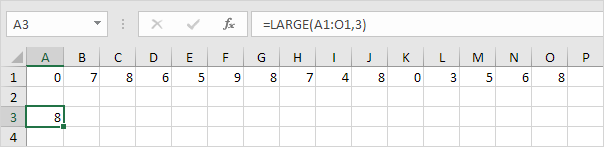
Check:

Small

To find the second smallest number, use the following SMALL function.
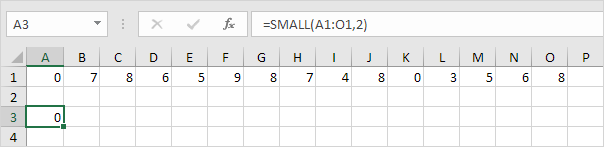
Check:

Tip: Excel can generate most of these results with the click of a button.

Post navigation

Previous Post:

TRUE function: Description, Usage, Syntax, Examples and Explanation

Next Post:

Excel Pie Chart

Leave a Reply Cancel reply

Your email address will not be published. Required fields are marked *

Learn Basic Excel

Ribbon
Workbook
Worksheets
Format Cells
Find & Select
Sort & Filter
Templates
Print
Share
Protect
Keyboard Shortcuts

Categories

  • Charts
  • Data Analysis
  • Data Validation
  • Excel Functions
    • Cube Functions
    • Database Functions
    • Date and Time Functions
    • Engineering Functions
    • Financial Functions
    • Information Functions
    • Logical Functions
    • Lookup and Reference Functions
    • Math and Trig Functions
    • Statistical Functions
    • Text Functions
    • Web Functions
  • Excel VBA
  • Excel Video Tutorials
  • Formatting
  • Grouping
  • Others

Logical Functions

  • Extract multiple matches into separate rows in Excel
  • TRUE function: Description, Usage, Syntax, Examples and Explanation
  • NOT function: Description, Usage, Syntax, Examples and Explanation
  • How to use IFS function in Excel
  • IFS function: Description, Usage, Syntax, Examples and Explanation

Date Time

  • Convert text to date in Excel
  • EOMONTH function: Description, Usage, Syntax, Examples and Explanation
  • ISOWEEKNUM function: Description, Usage, Syntax, Examples and Explanation
  • Display the current date in Excel
  • MONTH function: Description, Usage, Syntax, Examples and Explanation

Grouping

  • If cell contains one of many things in Excel
  • Group arbitrary text values in Excel
  • Group numbers with VLOOKUP in Excel
  • Group times into unequal buckets in Excel
  • Map inputs to arbitrary values in Excel

General

  • Customize Ribbon In Excel
  • Find Most Frequently Occurring Word in Excel Worksheet
  • How to add sequential row numbers to a set of data in Excel
  • Creating and Opening an existing file in Excel
  • 3D SUMIF for multiple worksheets in Excel
© 2026 xlsoffice . All Right Reserved. | Teal Smiles | Abbreviations And Their Meaning