
Skip to content
Free Excel Tutorials
  • Home
  • Excel For Beginners
  • Excel Intermediate
  • Advanced Excel For Experts

Data Analysis

  • How to create Gauge Chart in Excel
  • How To Load Analysis ToolPak in Excel
  • How to Create One and Two Variable Data Tables in Excel
  • Excel Line Chart
  • How to conditionally sum numeric data in an Excel table using SUMIFS

References

  • Multi-criteria lookup and transpose in Excel
  • Lookup entire row in Excel
  • Basic INDEX MATCH approximate in Excel
  • Left Lookup in Excel
  • How to get relative column numbers in a range in Excel

Data Validations

  • Excel Data validation whole percentage only
  • Excel Data validation number multiple 100
  • How To Create Drop-down List in Excel
  • Excel Data validation allow weekday only
  • Prevent invalid data entering in specific cells

Next biweekly payday from date in Excel

by

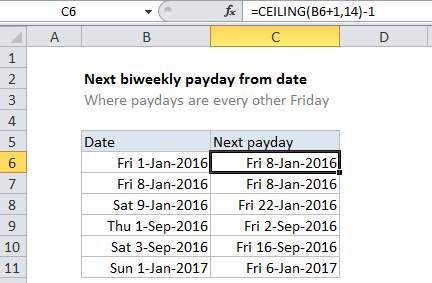
To get the next payday – assuming a biweekly schedule, with paydays on Friday – you can use a formula based on the CEILING function.

 Formula

=CEILING(date+1,14)-1
Explanation

In the example shown, the formula in C6 is:

=CEILING(B6+1,14)-1

Note: this formula assumes Excel’s default 1900 date system.

How this formula works

This formula depends on the CEILING function, which rounds numbers up to a given multiple. It works because how dates work in Excel’s default 1900 date system, where the first day in the system is the number 1, equal to the date Sunday January 1, 1900.

In this scheme, the first Friday is day number 6, the second Friday is day number 13, and day 14 is the second Saturday. What this means is that all second Saturday’s in the future are evenly divisible by 14.

The formula uses this fact to figure out 2nd Saturdays, then subtracts 1 to get the Friday previous.

The other every other Friday

If you need to get the alternate Friday in an every other Friday scheme, you can use this version of the formula:

=CEILING(A1+8,14)-8

The idea is the same, but the formula needs to roll forward  8 days to get to an even multiple of 14. Once CEILING returns a date, 8 days are subtracted to move back to the Friday previous.

Post navigation

Previous Post:

DECIMAL function: Description, Usage, Syntax, Examples and Explanation

Next Post:

AVERAGE function: Description, Usage, Syntax, Examples and Explanation

Leave a Reply Cancel reply

Your email address will not be published. Required fields are marked *

Learn Basic Excel

Ribbon
Workbook
Worksheets
Format Cells
Find & Select
Sort & Filter
Templates
Print
Share
Protect
Keyboard Shortcuts

Categories

  • Charts
  • Data Analysis
  • Data Validation
  • Excel Functions
    • Cube Functions
    • Database Functions
    • Date and Time Functions
    • Engineering Functions
    • Financial Functions
    • Information Functions
    • Logical Functions
    • Lookup and Reference Functions
    • Math and Trig Functions
    • Statistical Functions
    • Text Functions
    • Web Functions
  • Excel VBA
  • Excel Video Tutorials
  • Formatting
  • Grouping
  • Others

Logical Functions

  • How to use IFS function in Excel
  • Return blank if in Excel
  • IF with boolean logic in Excel
  • Not Equal To ‘<>‘ operator in Excel
  • NOT function: Description, Usage, Syntax, Examples and Explanation

Date Time

  • How to determine year is a leap year in Excel
  • How to show last updated date stamp in Excel
  • How to get number of days, weeks, months or years between two dates in Excel
  • Get last weekday in month in Excel
  • How to enter Today’s Date or Static Date and Time in Excel

Grouping

  • Group arbitrary text values in Excel
  • Calculate conditional mode with criteria in Excel
  • Map text to numbers in Excel
  • Group numbers with VLOOKUP in Excel
  • How to randomly assign people to groups in Excel

General

  • How to calculate percentage of total in Excel
  • How to get amount with percentage in Excel
  • Customize Ribbon In Excel
  • How to calculate percentage discount in Excel
  • 44 Practical Excel IF function Examples
© 2026 xlsoffice . All Right Reserved. | Teal Smiles | Abbreviations And Their Meaning