
Skip to content
Free Excel Tutorials
  • Home
  • Excel For Beginners
  • Excel Intermediate
  • Advanced Excel For Experts

Data Analysis

  • Create Scatter Chart in Excel
  • Example of COUNTIFS with variable table column in Excel
  • How to Create One and Two Variable Data Tables in Excel
  • How to add Trendline to a chart in Excel
  • Conditional Formatting Data bars Examples in Excel

References

  • CHOOSE function: Description, Usage, Syntax, Examples and Explanation
  • Convert text string to valid reference in Excel using Indirect function
  • How to get last row in text data in Excel
  • How to use Excel VLOOKUP Function
  • How to get address of named range in Excel

Data Validations

  • Excel Data validation must not contain
  • Data validation must not exist in list
  • How To Create Drop-down List in Excel
  • Excel Data validation allow weekday only
  • Excel Data validation date in specific year

Get work hours between dates and times in Excel

by

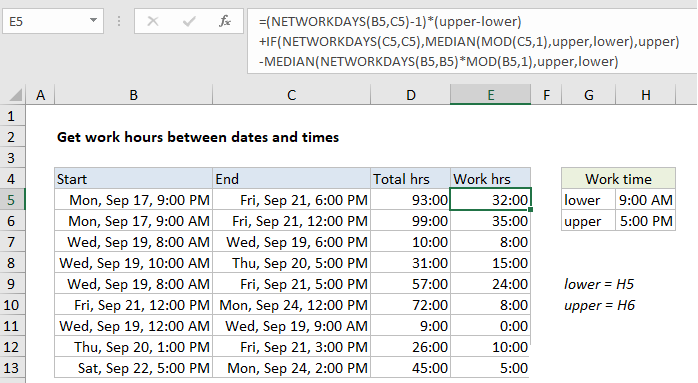
To calculate total work hours between two dates and times, you can use a formula based on the NETWORKDAYS function.

Formula

=(NETWORKDAYS(start,end)-1)*(upper-lower)
+IF(NETWORKDAYS(end,end),MEDIAN
(MOD(end,1),upper,lower),upper)
-MEDIAN(NETWORKDAYS(start,start)
*MOD(start,1),upper,lower)
Explanation

In the example shown, E5 contains this formula:

=(NETWORKDAYS(B5,C5)-1)*(upper-lower)
+IF(NETWORKDAYS(C5,C5),MEDIAN
(MOD(C5,1),upper,lower),upper)
-MEDIAN(NETWORKDAYS(B5,B5)
*MOD(B5,1),upper,lower)

where “lower” is the named range H5 and “upper” is the named range H6.

How this formula works

This formula calculates total working hours between two dates and times, that occur between a “lower” and “upper” time. In the example shown, the lower time is 9:00 AM and the upper time is 5:00 PM. These appear in the formula as the named ranges “lower” and “upper”.

The logic of the formula is to calculate all possible working hours between the start and end dates, inclusive, then back out any hours on the start date that occur between the start time and lower time, and any hours on the end date that occur between the end time and the upper time.

The NETWORKDAYS function handles the exclusion of weekends and holidays (when provided as a range of dates). You can switch to NETWORKDAYS.INTL if your schedule has non-standard working days.

Alternatively

If start and end times will always occur between lower and upper times, you can use a simpler version of this formula:

=(NETWORKDAYS(B5,C5)-1)*(upper-lower)
+MOD(C5,1)-MOD(B5,1)

No start time and end time

To calculate total work hours between two dates, assuming all days are full workdays, you can use an even simpler formula:

=NETWORKDAYS(start,end,holidays)*hours

Post navigation

Previous Post:

DECIMAL function: Description, Usage, Syntax, Examples and Explanation

Next Post:

AVERAGE function: Description, Usage, Syntax, Examples and Explanation

Leave a Reply Cancel reply

Your email address will not be published. Required fields are marked *

Learn Basic Excel

Ribbon
Workbook
Worksheets
Format Cells
Find & Select
Sort & Filter
Templates
Print
Share
Protect
Keyboard Shortcuts

Categories

  • Charts
  • Data Analysis
  • Data Validation
  • Excel Functions
    • Cube Functions
    • Database Functions
    • Date and Time Functions
    • Engineering Functions
    • Financial Functions
    • Information Functions
    • Logical Functions
    • Lookup and Reference Functions
    • Math and Trig Functions
    • Statistical Functions
    • Text Functions
    • Web Functions
  • Excel VBA
  • Excel Video Tutorials
  • Formatting
  • Grouping
  • Others

Logical Functions

  • IFERROR function: Description, Usage, Syntax, Examples and Explanation
  • Invoice status with nested if in Excel
  • IF function: Description, Usage, Syntax, Examples and Explanation
  • How to use Excel XOR Function
  • IFS function: Description, Usage, Syntax, Examples and Explanation

Date Time

  • Get fiscal year from date in Excel
  • Convert text to date in Excel
  • Generate series of dates by weekends in Excel
  • MONTH function: Description, Usage, Syntax, Examples and Explanation
  • Get days between dates in Excel

Grouping

  • Map inputs to arbitrary values in Excel
  • Group arbitrary text values in Excel
  • Group numbers at uneven intervals in Excel
  • Group times into 3 hour buckets in Excel
  • If cell contains one of many things in Excel

General

  • With vs Without Array Formula in Excel
  • How to calculate percent variance in Excel
  • How to create dynamic named range with INDEX in Excel
  • Zoom Worksheet in Excel
  • Transpose: Switch ‘Rows to Columns’ or ‘Columns to Rows’ in Excel
© 2025 xlsoffice . All Right Reserved. | Teal Smiles | Abbreviations And Their Meaning