
Skip to content
Free Excel Tutorials
  • Home
  • Excel For Beginners
  • Excel Intermediate
  • Advanced Excel For Experts

Data Analysis

  • Data Series in Excel
  • How To Create Frequency Distribution in Excel
  • Add Outline to Data in Excel
  • How To Insert and Customize Sparklines in Excel
  • How to create Gauge Chart in Excel

References

  • VLOOKUP function: Description, Usage, Syntax, Examples and Explanation
  • How to get last row in mixed data with blanks in Excel
  • Multi-criteria lookup and transpose in Excel
  • Count unique text values with criteria
  • Approximate match with multiple criteria in Excel

Data Validations

  • How To Create Drop-down List in Excel
  • Excel Data validation only dates between
  • Excel Data validation must not contain
  • Excel Data validation must begin with
  • Excel Data validation exists in list

Custom weekday abbreviation in Excel

by

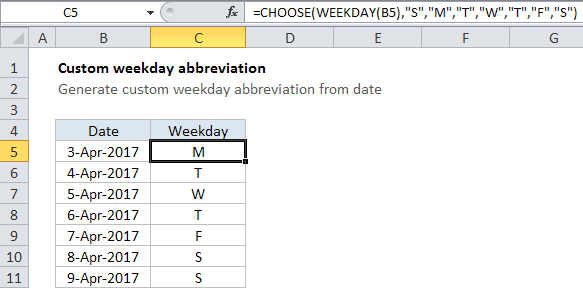
This tutorial shows how to create custom weekday abbreviation in Excel using example below.

To create a custom weekday abbreviation, you can use a formula based on the CHOOSE and WEEKDAY functions. With this approach, you can generate a custom one-letter abbreviation, two-letter abbreviation, or any weekday that makes sense in your particular situation.

Formula

=CHOOSE(WEEKDAY(date),"S","M","T","W","T","F","S")
Explanation

In the example shown, the formula in C5 is:

=CHOOSE(WEEKDAY(B5),"S","M","T","W","T","F","S")

How this formula works

Working from the inside-out, the WEEKDAY function takes a date and returns a number between 1 and 7. With default settings, the number 1 corresponds to Sunday and the number 7 corresponds to Saturday.

The CHOOSE function simply maps numbers to values. The first argument is the number to map, and subsequent arguments represent associated values.

In this case, 7 values have been provided in the order required to work with WEEKDAY’s Sunday through Saturday scheme.

With a date from column B, WEEKDAY returns a number which is fed to the CHOOSE function. CHOOSE returns the value at that position in the list of abbreviations.

Post navigation

Previous Post:

DECIMAL function: Description, Usage, Syntax, Examples and Explanation

Next Post:

AVERAGE function: Description, Usage, Syntax, Examples and Explanation

Leave a Reply Cancel reply

Your email address will not be published. Required fields are marked *

Learn Basic Excel

Ribbon
Workbook
Worksheets
Format Cells
Find & Select
Sort & Filter
Templates
Print
Share
Protect
Keyboard Shortcuts

Categories

  • Charts
  • Data Analysis
  • Data Validation
  • Excel Functions
    • Cube Functions
    • Database Functions
    • Date and Time Functions
    • Engineering Functions
    • Financial Functions
    • Information Functions
    • Logical Functions
    • Lookup and Reference Functions
    • Math and Trig Functions
    • Statistical Functions
    • Text Functions
    • Web Functions
  • Excel VBA
  • Excel Video Tutorials
  • Formatting
  • Grouping
  • Others

Logical Functions

  • Invoice status with nested if in Excel
  • FALSE function: Description, Usage, Syntax, Examples and Explanation
  • IF function: Description, Usage, Syntax, Examples and Explanation
  • XOR function: Description, Usage, Syntax, Examples and Explanation
  • Not Equal To ‘<>‘ operator in Excel

Date Time

  • Get days before a date in Excel
  • Get project end date in Excel
  • Get month from date in Excel
  • How to calculate next scheduled event in Excel
  • Calculate time difference in hours as decimal value in Excel

Grouping

  • Group numbers with VLOOKUP in Excel
  • Group times into unequal buckets in Excel
  • Group times into 3 hour buckets in Excel
  • Map text to numbers in Excel
  • How to randomly assign data to groups in Excel

General

  • How to calculate percent of goal in Excel
  • Sum by group in Excel
  • Creating and Opening an existing file in Excel
  • How to generate random number between two numbers in Excel
  • Basic text sort formula in Excel
© 2025 xlsoffice . All Right Reserved. | Teal Smiles | Abbreviations And Their Meaning