
Skip to content
Free Excel Tutorials
  • Home
  • Excel For Beginners
  • Excel Intermediate
  • Advanced Excel For Experts

Data Analysis

  • Conditional Formatting Color Scales Examples in Excel
  • Randomize/ Shuffle List in Excel
  • Conflicting Multiple Conditional Formatting Rules in Excel
  • How to create Gauge Chart in Excel
  • Create Scatter Chart in Excel

References

  • Left Lookup in Excel
  • INDEX function: Description, Usage, Syntax, Examples and Explanation
  • Lookup entire row in Excel
  • Convert text string to valid reference in Excel using Indirect function
  • How to get relative row numbers in a range in Excel

Data Validations

  • Excel Data validation date in next 30 days
  • How To Create Drop-down List in Excel
  • Excel Data validation must begin with
  • Excel Data validation allow uppercase only
  • Excel Data validation unique values only

Create date range from two dates in Excel

by

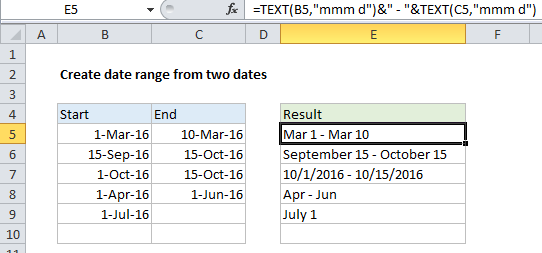
This tutorial shows how to Create date range from two dates in Excel using example below.

To display a date range in one cell based on dates in different cells, you can use a formula based on the TEXT function.

Formula

=TEXT(date1,"format")&" - "&TEXT(date2,"format")
Explanation

In the example shown, the formula in cell E5 is:

=TEXT(B5,"mmm d")&" - "&TEXT(C5,"mmm d")

How this formula works

The TEXT function takes numeric values and converts them to text values using the format you specify. In this example, we are using the format “mmm d” for both TEXT functions in E5. The results are joined with a hyphen using simple concatenation.

Note: the other examples in column E all use different text formats.

End date missing

If the end date is missing, the formula won’t work correctly because the hyphen will still be appended to the start date (e.g.”March 1 – “).

To handle this case, you can wrap the concatenation and second TEXT function inside IF like so:

=TEXT(date1,"mmm d")&IF(date2<>""," - "&TEXT(date2,"mmm d"),"")

This creates the full date range when both dates are present, but outputs only the start date when the end date is missing.

Start date missing

To handle a case where both dates are missing, you could nest another IF like this:

=IF(date1<>"",TEXT(date1,"mmmm d")&IF(date2<>""," - "&TEXT(date2,"mmm d"),""),"")

This formula simply returns an empty string (“”) when date1 is not available.

Post navigation

Previous Post:

DECIMAL function: Description, Usage, Syntax, Examples and Explanation

Next Post:

AVERAGE function: Description, Usage, Syntax, Examples and Explanation

Leave a Reply Cancel reply

Your email address will not be published. Required fields are marked *

Learn Basic Excel

Ribbon
Workbook
Worksheets
Format Cells
Find & Select
Sort & Filter
Templates
Print
Share
Protect
Keyboard Shortcuts

Categories

  • Charts
  • Data Analysis
  • Data Validation
  • Excel Functions
    • Cube Functions
    • Database Functions
    • Date and Time Functions
    • Engineering Functions
    • Financial Functions
    • Information Functions
    • Logical Functions
    • Lookup and Reference Functions
    • Math and Trig Functions
    • Statistical Functions
    • Text Functions
    • Web Functions
  • Excel VBA
  • Excel Video Tutorials
  • Formatting
  • Grouping
  • Others

Logical Functions

  • Not Equal To ‘<>‘ operator in Excel
  • Extract multiple matches into separate rows in Excel
  • AND function: Description, Usage, Syntax, Examples and Explanation
  • Check multiple cells are equal in Excel
  • OR function: Description, Usage, Syntax, Examples and Explanation

Date Time

  • How to calculate Quarter of Date in Excel
  • Count birthdays by month in Excel
  • How to join date and text together in Excel
  • SECOND function: Description, Usage, Syntax, Examples and Explanation
  • Assign points based on late time in Excel

Grouping

  • How to randomly assign data to groups in Excel
  • If cell contains one of many things in Excel
  • Calculate conditional mode with criteria in Excel
  • Group numbers with VLOOKUP in Excel
  • Group arbitrary text values in Excel

General

  • Basic error trapping example in Excel
  • How to calculate profit margin percentage in Excel
  • How to calculate percent of students absent in Excel
  • Create dynamic workbook reference to another workbook in Excel
  • Find, Select, Replace and Go To Special in Excel
© 2026 xlsoffice . All Right Reserved. | Teal Smiles | Abbreviations And Their Meaning