
Skip to content
Free Excel Tutorials
  • Home
  • Excel For Beginners
  • Excel Intermediate
  • Advanced Excel For Experts

Data Analysis

  • How to sum a total in multiple Excel tables
  • How to conditionally sum numeric data in an Excel table using SUMIFS
  • How To Create Pareto Chart in Excel
  • Use Data Form to input, edit and delete records in Excel
  • Move chart to a separate worksheet in Excel

References

  • How to use Excel FORMULATEXT function
  • Lookup entire row in Excel
  • How to get last row in text data in Excel
  • CHOOSE function: Description, Usage, Syntax, Examples and Explanation
  • How to get last row in numeric data in Excel

Data Validations

  • Excel Data validation don’t exceed total
  • Excel Data validation allow uppercase only
  • Excel Data validation number multiple 100
  • Excel Data validation date in next 30 days
  • Excel Data validation must contain specific text

Convert Excel time to decimal hours in Excel

by

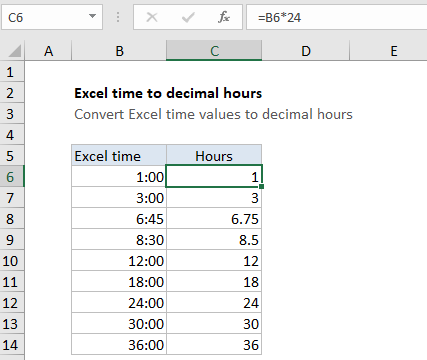
This tutorial shows how to Convert Excel time to decimal hours  using example below.

To convert a valid Excel time into decimal hours, simply multiply by 24.

 Formula

=A1*24
Explanation

In the example shown, the formula in C6 is:

=B6*24

which returns a value of 1.

How this formula works

In the Excel time system, one 24-hour day is equal to 1. This means times and hours are fractional values of 1, as shown in the table below:

Hours Time Fraction Value
1 1:00 AM 1/24 0.04167
3 3:00 AM 3/24 0.125
6 6:00 AM 6/24 0.25
4 4:00 AM 4/24 0.167
8 8:00 AM 8/24 0.333
12 12:00 PM 12/24 0.5
18 6:00 PM 18/24 0.75
21 9:00 PM 21/24 0.875

Because each hour can be represented as 1/24,  you can convert an Excel time into decimal hours by multiplying the value by 24. For example, with the time value 6:00 cell A1, you can visualize the conversion like this:

=A1*24
=(6/24)*24
=0.25*24
=6

Post navigation

Previous Post:

DECIMAL function: Description, Usage, Syntax, Examples and Explanation

Next Post:

AVERAGE function: Description, Usage, Syntax, Examples and Explanation

Leave a Reply Cancel reply

Your email address will not be published. Required fields are marked *

Learn Basic Excel

Ribbon
Workbook
Worksheets
Format Cells
Find & Select
Sort & Filter
Templates
Print
Share
Protect
Keyboard Shortcuts

Categories

  • Charts
  • Data Analysis
  • Data Validation
  • Excel Functions
    • Cube Functions
    • Database Functions
    • Date and Time Functions
    • Engineering Functions
    • Financial Functions
    • Information Functions
    • Logical Functions
    • Lookup and Reference Functions
    • Math and Trig Functions
    • Statistical Functions
    • Text Functions
    • Web Functions
  • Excel VBA
  • Excel Video Tutorials
  • Formatting
  • Grouping
  • Others

Logical Functions

  • TRUE function: Description, Usage, Syntax, Examples and Explanation
  • How to use IFS function in Excel
  • How to use Excel TRUE Function
  • How to use Excel NOT Function
  • Extract multiple matches into separate rows in Excel

Date Time

  • How to calculate project start date based on end date in Excel
  • How to calculate percent of year complete in Excel
  • How to calculate future date say 6 months ahead in Excel
  • DAYS function: Description, Usage, Syntax, Examples and Explanation
  • Display the current date in Excel

Grouping

  • Group numbers at uneven intervals in Excel
  • Categorize text with keywords in Excel
  • How to randomly assign data to groups in Excel
  • Group arbitrary text values in Excel
  • Running count group by n size in Excel

General

  • How to get Excel workbook path only
  • Customize Ribbon In Excel
  • Freeze and Unfreeze Panes in Excel
  • How to choose page/paper size in Excel before Printing
  • How to generate random times at specific intervals in Excel
© 2026 xlsoffice . All Right Reserved. | Teal Smiles | Abbreviations And Their Meaning