
Skip to content
Free Excel Tutorials
  • Home
  • Excel For Beginners
  • Excel Intermediate
  • Advanced Excel For Experts

Data Analysis

  • How to count table columns in Excel
  • How to add Trendline to a chart in Excel
  • Subtotal function in Excel
  • How to create running total in an Excel Table
  • How To Create Pareto Chart in Excel

References

  • Count rows that contain specific values in Excel
  • Two-column Lookup in Excel
  • VLOOKUP function: Description, Usage, Syntax, Examples and Explanation
  • How to use Excel MMULT Function
  • Merge tables with VLOOKUP in Excel

Data Validations

  • Prevent invalid data entering in specific cells
  • Excel Data validation with conditional list
  • Excel Data validation allow weekday only
  • Excel Data validation must begin with
  • Excel Data validation don’t exceed total

Add workdays no weekends in Excel

by

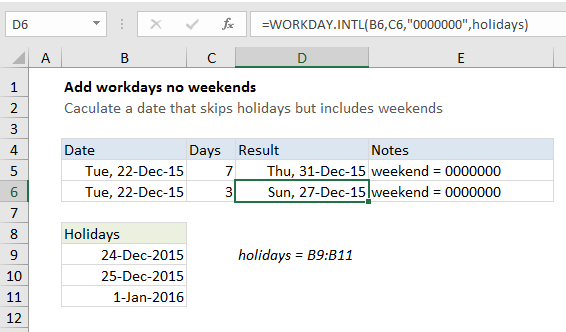
It you need to add workdays no weekends in Excel then this tutorials is for you. See example below:

Therefore, To add or subtract workdays days to a date, respecting holidays but assuming a 7-day workweek, you can you can use the WORKDAY.INTL function.

Formula

=WORKDAY.INTL(start_date,days,"0000000", holidays)
Explanation

In the example, the formula in D6 is:

=WORKDAY.INTL(B6,C6,"0000000",holidays)

This formula adds 7 workdays days to Tuesday, Dec 22. Three holidays are supplied using the named range “holidays” (B9:B11) and weekends are set using the special syntax “0000000” which means all days in a week are workdays. The result is Thu, December 31, 2015.

How this formula works

The WORKDAY.INTL can calculate a date in the future or past that respects holidays and weekends. To specify which days are considered weekends, you can use a special code (full list of codes here) or use a “mask” to indicate weekends with ones and zeros.  The mask method is more flexible, since it allows you to designate any day of the week as a weekend (i.e. non-working day). For example:

=WORKDAY.INTL(A1,3,"0000000") // no weekends
=WORKDAY.INTL(A1,3,"1000000") // weekend = Mon
=WORKDAY.INTL(A1,3,"1100000") // weekend = Mon+Tue
=WORKDAY.INTL(A1,3,"1110000") // weekend = Mon+Tue+Wed

The weekend argument is supplied as 7 characters that represent Monday-Sunday. Use one (1) to indicate weekend, and zero (0) to indicate a working day.

Since we want all days of the week to be considered working days, we use “0000000”.

Post navigation

Previous Post:

COSH function: Description, Usage, Syntax, Examples and Explanation

Next Post:

Excel Data validation require unique number

Leave a Reply Cancel reply

Your email address will not be published. Required fields are marked *

Learn Basic Excel

Ribbon
Workbook
Worksheets
Format Cells
Find & Select
Sort & Filter
Templates
Print
Share
Protect
Keyboard Shortcuts

Categories

  • Charts
  • Data Analysis
  • Data Validation
  • Excel Functions
    • Cube Functions
    • Database Functions
    • Date and Time Functions
    • Engineering Functions
    • Financial Functions
    • Information Functions
    • Logical Functions
    • Lookup and Reference Functions
    • Math and Trig Functions
    • Statistical Functions
    • Text Functions
    • Web Functions
  • Excel VBA
  • Excel Video Tutorials
  • Formatting
  • Grouping
  • Others

Logical Functions

  • SWITCH function: Description, Usage, Syntax, Examples and Explanation
  • IFS function: Description, Usage, Syntax, Examples and Explanation
  • How to return blank in place of #DIV/0! error in Excel
  • How to use Excel OR Function
  • How to use Excel AND Function

Date Time

  • Add years to date in Excel
  • Steps to create Dynamic calendar grid in Excel
  • DATEVALUE function: Description, Usage, Syntax, Examples and Explanation
  • Count day of week between dates in Excel
  • Add days exclude certain days of week in Excel

Grouping

  • Group times into 3 hour buckets in Excel
  • Group arbitrary text values in Excel
  • If cell contains one of many things in Excel
  • Map text to numbers in Excel
  • Group numbers at uneven intervals in Excel

General

  • Cell References: Relative, Absolute and Mixed Referencing Examples
  • How to calculate percent change in Excel
  • Create dynamic workbook reference to another workbook in Excel
  • List worksheet index numbers in Excel
  • How to generate random number weighted probability in Excel
© 2026 xlsoffice . All Right Reserved. | Teal Smiles | Abbreviations And Their Meaning