
Skip to content
Free Excel Tutorials
  • Home
  • Excel For Beginners
  • Excel Intermediate
  • Advanced Excel For Experts

Data Analysis

  • Chart Axes in Excel
  • How to Create Gantt Chart in Excel
  • How to add Trendline to a chart in Excel
  • Conditional Formatting New Rule with Formulas in Excel
  • Managing Conditional Formatting Rules in Excel

References

  • Count rows that contain specific values in Excel
  • How to use Excel ROW Function
  • How to get last row in text data in Excel
  • How to use Excel OFFSET function
  • How to get relative column numbers in a range in Excel

Data Validations

  • Excel Data validation unique values only
  • Excel Data validation allow uppercase only
  • Excel Data validation allow weekday only
  • Excel Data validation date in specific year
  • Excel Data validation must begin with

How to create simple in-cell histogram in Excel

by

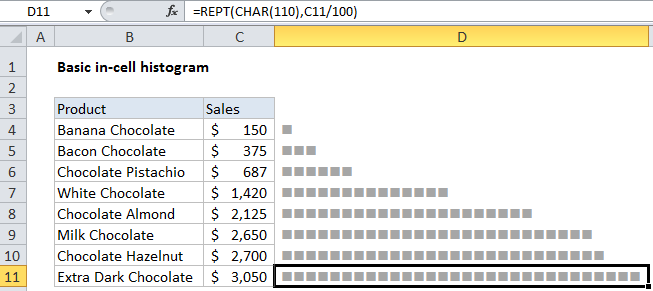
To create a simple in-cell histogram, you can use a formula based on the REPT function. This can be handy when you have straightforward data, and want to avoid the complexity of a separate chart.

Formula

=REPT(barchar,value/100)
Explanation

In the example shown, the formula is:

=REPT(CHAR(110),C11/100)

How this formula works

The REPT function simply repeats values. For example, this formula outputs 10 asterisks:

=REPT("*",10) // outputs **********

You can use REPT to repeat any character(s) you like. In this example, we use the CHAR function to output a character with a code of 110. This character, when formatted with the Wingdings font, will output a solid square.

CHAR(110) // square in Wingdings

To calculate the “number of times” for REPT, we scale values in column C by dividing each value by 100.

C11/100 // scale values down

This has the effect of outputting one full square per 100 dollars of sales. Increase or decrease the divisor to suit the data and available space.

Alternatively, Conditional formattingĀ can be used

You can also use the “data bars” feature in conditional formatting to display an in cell bar.

Post navigation

Previous Post:

How to calculate project complete percentage in Excel

Next Post:

Popularly Used Excel Functions and their examples

Leave a Reply Cancel reply

Your email address will not be published. Required fields are marked *

Learn Basic Excel

Ribbon
Workbook
Worksheets
Format Cells
Find & Select
Sort & Filter
Templates
Print
Share
Protect
Keyboard Shortcuts

Categories

  • Charts
  • Data Analysis
  • Data Validation
  • Excel Functions
    • Cube Functions
    • Database Functions
    • Date and Time Functions
    • Engineering Functions
    • Financial Functions
    • Information Functions
    • Logical Functions
    • Lookup and Reference Functions
    • Math and Trig Functions
    • Statistical Functions
    • Text Functions
    • Web Functions
  • Excel VBA
  • Excel Video Tutorials
  • Formatting
  • Grouping
  • Others

Logical Functions

  • SWITCH function example in Excel
  • IF with wildcards in Excel
  • How to return blank in place of #DIV/0! error in Excel
  • Return blank if in Excel
  • IFNA function: Description, Usage, Syntax, Examples and Explanation

Date Time

  • Generate series of dates by weekends in Excel
  • DAY function: Description, Usage, Syntax, Examples and Explanation
  • Convert text to date in Excel
  • Get project end date in Excel
  • Convert decimal minutes to Excel time

Grouping

  • How to randomly assign people to groups in Excel
  • How to randomly assign data to groups in Excel
  • Group times into unequal buckets in Excel
  • Categorize text with keywords in Excel
  • Group times into 3 hour buckets in Excel

General

  • How to generate random times at specific intervals in Excel
  • How to get original price from percentage discount in Excel
  • How to choose page/paper size in Excel before Printing
  • How to calculate percentage discount in Excel
  • Sum by group in Excel
© 2025 xlsoffice . All Right Reserved. | Teal Smiles | Abbreviations And Their Meaning