
Skip to content
Free Excel Tutorials
  • Home
  • Excel For Beginners
  • Excel Intermediate
  • Advanced Excel For Experts

Data Analysis

  • How to create running total in an Excel Table
  • Managing Conditional Formatting Rules in Excel
  • Get column index in Excel Table
  • Data Series in Excel
  • Randomize/ Shuffle List in Excel

References

  • How to use Excel ROW Function
  • Complete List of Excel Lookup and Reference Functions, References and Examples
  • Count unique text values with criteria
  • How to use Excel OFFSET function
  • How to get first row number in range in Excel

Data Validations

  • Excel Data validation unique values only
  • Excel Data validation with conditional list
  • Excel Data validation whole percentage only
  • Excel Data validation date in next 30 days
  • How To Create Drop-down List in Excel

Sum race time splits in Excel

by

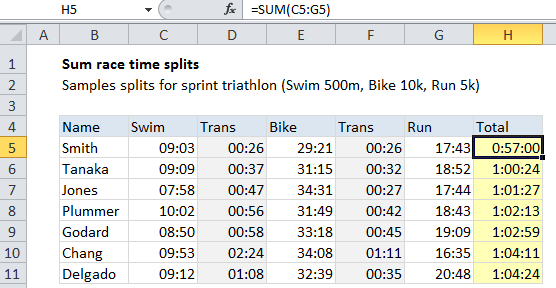
If you need to add up (sum) up race time splits that are some combination of hours, minutes, and seconds, you can simply use the SUM function.

However, you must take care to enter times with the right syntax and use a suitable time format to display results, as explained below.

Formula

=SUM(range)
Explanation

The formula in cell H5 is:

=SUM(C5:G5)

Enter times in correct format

You must be sure that times are correctly entered in hh:mm:ss format. For example, to enter a time of 9 minutes, 3 seconds, type: 0:09:03

Excel will show the time in the formula bar as 12:09:03 AM, but will record the time properly as a decimal value.

Internally, Excel tracks times as decimal numbers, where 1 hour = 1/24, 1 minute = 1/(24*60), and 1 second = 1/(24*60*60). How Excel displays time depends on what number format is applied.

Use a suitable time format

When working with times, you must take care to use a time format that makes sense to display times that represent durations.

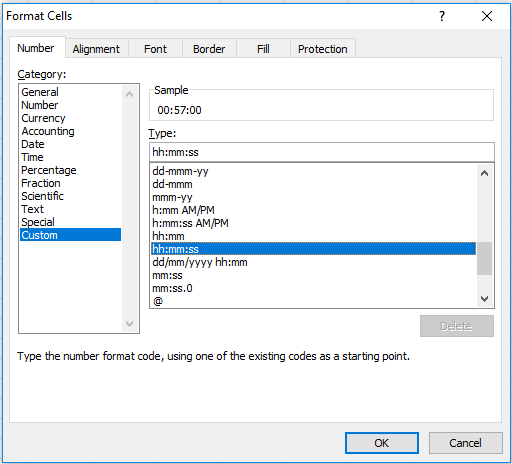
To access and apply custom time formats, select the cell(s), then use Control + 1 (Command + 1 on a Mac), then Number > Custom.

These are the number formats used in the example shown:

mm:ss // split times
h:mm:ss // total time

If total times may exceed 24 hours, use this format:

[h]:mm:ss

The square bracket syntax tells Excel not to “roll over” times greater than 24 hours.
Post navigation

Previous Post:

DECIMAL function: Description, Usage, Syntax, Examples and Explanation

Next Post:

AVERAGE function: Description, Usage, Syntax, Examples and Explanation

Leave a Reply Cancel reply

Your email address will not be published. Required fields are marked *

Learn Basic Excel

Ribbon
Workbook
Worksheets
Format Cells
Find & Select
Sort & Filter
Templates
Print
Share
Protect
Keyboard Shortcuts

Categories

  • Charts
  • Data Analysis
  • Data Validation
  • Excel Functions
    • Cube Functions
    • Database Functions
    • Date and Time Functions
    • Engineering Functions
    • Financial Functions
    • Information Functions
    • Logical Functions
    • Lookup and Reference Functions
    • Math and Trig Functions
    • Statistical Functions
    • Text Functions
    • Web Functions
  • Excel VBA
  • Excel Video Tutorials
  • Formatting
  • Grouping
  • Others

Logical Functions

  • How to use Excel XOR Function
  • IFERROR function: Description, Usage, Syntax, Examples and Explanation
  • IF, AND, OR and NOT Functions Examples in Excel
  • Not Equal To ‘<>‘ operator in Excel
  • Return blank if in Excel

Date Time

  • Calculate date overlap in days in Excel
  • Convert text date dd/mm/yy to mm/dd/yy in Excel
  • Get date from day number in Excel
  • Create date range from two dates in Excel
  • How to calculate quarter from date in Excel

Grouping

  • Group times into unequal buckets in Excel
  • How to randomly assign people to groups in Excel
  • Group numbers at uneven intervals in Excel
  • Map text to numbers in Excel
  • How to randomly assign data to groups in Excel

General

  • How to create dynamic worksheet reference in Excel
  • How to calculate percent sold in Excel
  • 231 Keyboard Shortcut Keys In Excel
  • Check if multiple cells have same value in Excel
  • Cell References: Relative, Absolute and Mixed Referencing Examples
© 2026 xlsoffice . All Right Reserved. | Teal Smiles | Abbreviations And Their Meaning