
Skip to content
Free Excel Tutorials
  • Home
  • Excel For Beginners
  • Excel Intermediate
  • Advanced Excel For Experts

Data Analysis

  • How to create Gauge Chart in Excel
  • Understanding Pivot Tables in Excel
  • Subtotal function in Excel
  • Create Scatter Chart in Excel
  • How to Use Solver Tool in Excel

References

  • Vlookup Examples in Excel
  • How to use Excel INDIRECT Function
  • Offset in Excel
  • How to get first row number in range in Excel
  • Lookup entire row in Excel

Data Validations

  • Excel Data validation allow uppercase only
  • Excel Data validation number multiple 100
  • Prevent invalid data entering in specific cells
  • Excel Data validation must contain specific text
  • Excel Data validation date in next 30 days

Highlight numbers that include symbols in Excel

by

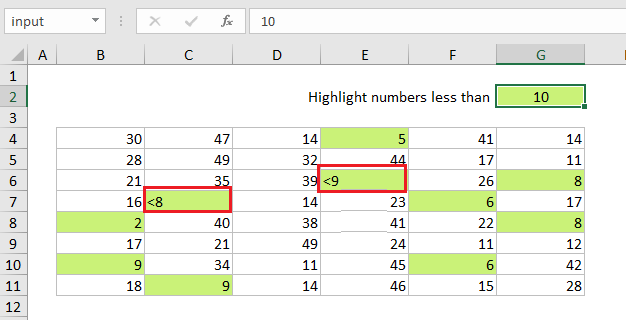
This tutorial shows how to Highlight numbers that include symbols in Excel using the example below;

Formula

=IF(ISNUMBER(B4),B4<input,IF(LEFT(B4)="<",(MID(B4,2,LEN(B4))+0)<input))
Explanation

To highlight numbers less than a certain value, including numbers entered as text like “<9”, “<10”, etc., you can use conditional formatting with a formula strips the symbols as needed and handles the result as a number. In the example shown, “input” is a named range for cell G2.

How this formula works

The formula first uses the ISNUMBER function to test if the value is a number, and applies a simple logical if so:

=IF(ISNUMBER(B4)

For any number less than the value in “input”, the formula will return TRUE and the conditional formatting will be applied.

However, if the value is not a number, the formula then checks if the first character is a less than symbol (<) using the LEFT function:

IF(LEFT(B4)="<"

If so, the MID function is used to extract everything after the symbol:

MID(B4,2,LEN(B4)

Technically, the LEN function returns a number 1 greater than we need, since it includes the “<” symbol as well. If this bothers you, feel free to subtract 1.

The result of MID is always text so the formula adds zero to force a Excel to convert the text to a number. This number is then compared to the value from “input”.

Post navigation

Previous Post:

COSH function: Description, Usage, Syntax, Examples and Explanation

Next Post:

Excel Data validation require unique number

Leave a Reply Cancel reply

Your email address will not be published. Required fields are marked *

Learn Basic Excel

Ribbon
Workbook
Worksheets
Format Cells
Find & Select
Sort & Filter
Templates
Print
Share
Protect
Keyboard Shortcuts

Categories

  • Charts
  • Data Analysis
  • Data Validation
  • Excel Functions
    • Cube Functions
    • Database Functions
    • Date and Time Functions
    • Engineering Functions
    • Financial Functions
    • Information Functions
    • Logical Functions
    • Lookup and Reference Functions
    • Math and Trig Functions
    • Statistical Functions
    • Text Functions
    • Web Functions
  • Excel VBA
  • Excel Video Tutorials
  • Formatting
  • Grouping
  • Others

Logical Functions

  • How to use Excel XOR Function
  • How to use Excel FALSE Function
  • How to return blank in place of #DIV/0! error in Excel
  • How to use Excel NOT Function
  • How to use Excel AND Function

Date Time

  • Convert date to Julian format in Excel
  • Add decimal minutes to time in Excel
  • Convert Excel time to Unix time in Excel
  • Convert text to date in Excel
  • NETWORKDAYS.INTL function: Description, Usage, Syntax, Examples and Explanation

Grouping

  • Group numbers with VLOOKUP in Excel
  • How to randomly assign data to groups in Excel
  • Group numbers at uneven intervals in Excel
  • Categorize text with keywords in Excel
  • Group arbitrary text values in Excel

General

  • Sum by group in Excel
  • Subtotal by invoice number in Excel
  • Index and match on multiple columns in Excel
  • Check if multiple cells have same value in Excel
  • Check if range contains a value not in another range in Excel
© 2026 xlsoffice . All Right Reserved. | Teal Smiles | Abbreviations And Their Meaning